4.02
Access, clearance and service room
Openings, trim, rails, weight, gas and water connections and the clearances an appliance needs to cool itself. The practical half of a repair, and the half most often underestimated.
- Category
- Installation
- Equipment
- Range · Rangetop · Cooktop · Wall oven · Convection steam oven · Speed oven · Warming drawer · Ventilation hood
4.2.1 Almost everything is behind the appliance
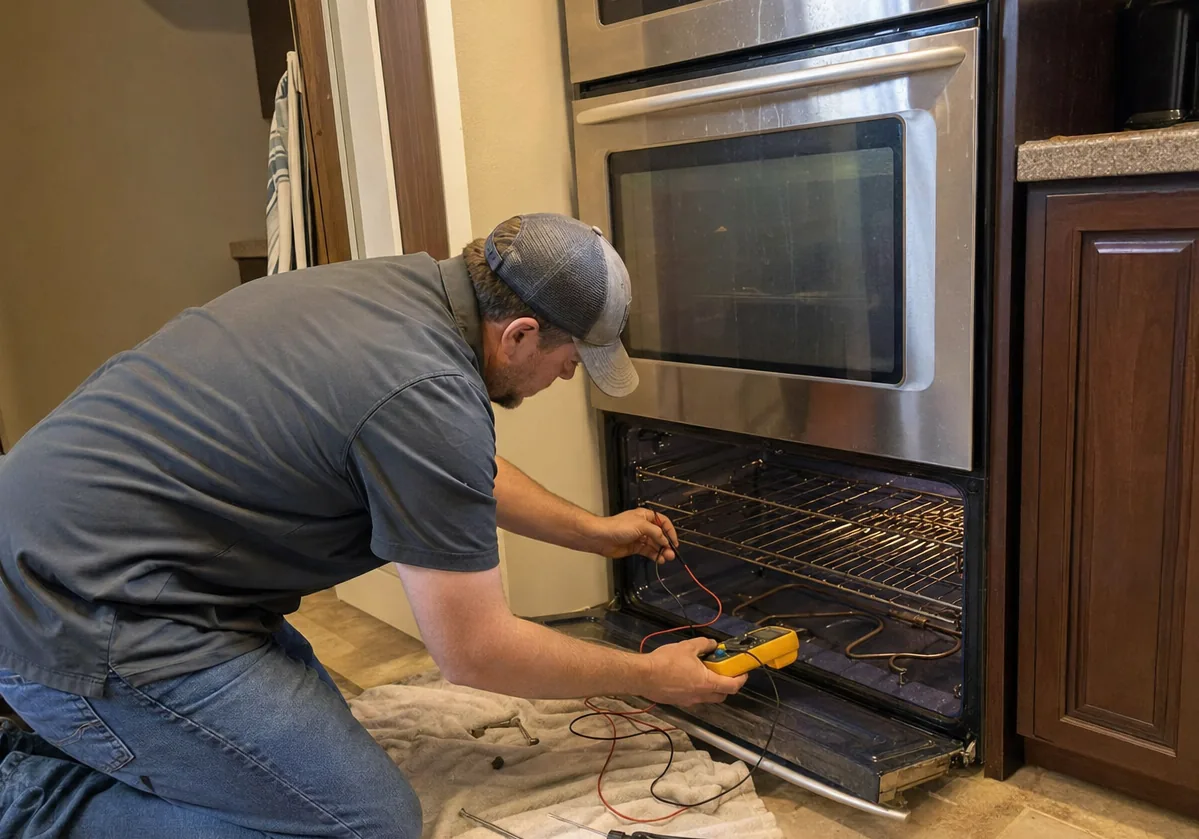
A free-standing range is serviced by pulling it forward a few feet. Built-in equipment is not: the parts that fail — boards, valves, blowers, fill pumps, sensors, terminal blocks — are behind or beneath the appliance, and the appliance is fixed into an opening cut to its own dimensions and trimmed to the cabinetry around it.
So the first part of most repairs is getting the machine far enough out to work on it, and the second is putting it back so the doors line up and the trim sits flat. That is not overhead; it is the job. Understanding it is why some visits finish in an hour and others need a return.
4.2.2 The opening decides more than people expect
Cut-outs are model-specific. A wall oven sits in a framed void with the depth, width and height its own installation instructions specified, and a rangetop drops into a counter cut-out with its own required clearances to combustibles at the sides and back. Cabinetry finished after the appliance went in — a lining added, a panel screwed across the back of a column, a filler strip fitted tight to the trim — changes those dimensions, and the appliance cannot be withdrawn without undoing it first.
This is also why replacement is rarely the simple option it appears to be. A current model is under no obligation to match the opening the old one leaves behind, so a replacement that looks like a delivery can turn into cabinetry work and, for a cooktop, a new counter cut.
4.2.3 Weight, rails and two-person work
Built-in ovens are heavy, and the weight is carried well forward of the cabinet’s face once the unit is drawn out. Units mounted high in a column are a two-person lift onto a stand, not a one-person shuffle, and a drawer or oven running on rails has to be released from them properly rather than dragged.
The practical requirements are ordinary: a clear route from the door to the kitchen, somewhere to stand the appliance while the work happens, floor protection, and enough room in front of the opening for two people and a lift. An island installation with a two-foot walkway behind it is a different job from the same appliance in an open run.
4.2.4 The connections behind it
How far an appliance can come forward is usually decided by what is attached to it.
Gas equipment should be on a flexible connector with an accessible shutoff, and the connector’s length sets the travel available. Where a rigid pipe was run instead, the supply has to be broken to move the appliance at all.
Electric equipment is hard-wired into a junction box or on a plug behind the cabinet; either way the cable length sets the limit, and large cooking equipment should be on a dedicated circuit rather than sharing one.
Plumbed steam ovens have a supply line and an isolating valve, and both need to be reachable. A machine plumbed with no accessible shutoff is a repair that starts with finding one.
Ventilation adds a duct connection at the top and, on remote-blower systems, a cable run into the attic space.
4.2.5 Clearance is also a fault cause
The same subject in reverse: an appliance that cannot get rid of its own heat protects itself. Induction electronics are temperature-limited and will cut power rather than fail; ovens open a thermal cutout. Both present as an intermittent electronic fault and are, more often than owners expect, a drawer loaded to the roof under a cooktop, a vent path blocked by stored packaging, or a cabinet closed in after installation.
Before condemning a board on an appliance that cuts out, we clear the cavity around it and run it again. That single step has ended a good number of visits.
4.2.6 What is worth telling us when you book
Whether the appliance is built in or free-standing. Whether it sits at floor level, at eye level in a column, or in an island. Whether the community is gated and how you want entry handled. Whether the carry from where a van can stand is long, or involves stairs. And, if you can, a photograph of the data plate.
None of that changes what the visit costs. It changes whether the repair finishes on the day.
4.2.7 Where our scope ends
We move appliances to service them; we do not modify cabinetry, cut counters or alter gas and electrical supplies beyond the appliance’s own connection. Where the honest answer is a cabinetmaker, an electrician or a plumber, we say so at the diagnostic and put it in writing, so the next trade knows exactly what is required rather than starting again.
What does the repair behind this note cost?
$80 flat to come out and find the fault, credited in full against the repair when you approve it. Beyond that, the work below is what these jobs run to once parts and labour are counted — $80 at the low end, $1,070 at the top of the widest band on this page.
| No. | Work | Completed, parts and labour |
|---|---|---|
| 4.02.6.01 | Flat diagnostic fee | $80 |
| 4.02.6.02 | Oven thermostat or temperature sensor | $180–$520 |
| 4.02.6.03 | Burner valve or orifice service | $230–$660 |
| 4.02.6.04 | Igniter or spark module replacement | $190–$550 |
| 4.02.6.05 | Control board or touch panel | $460–$1,070 |
A range, because the firm figure is written down after the diagnosis and not before it. The band a job lands in depends on which part failed, whether the appliance has to come out of the cabinetry to reach it, and what the part costs the week it is ordered. A written estimate is provided before any repair begins. No work starts without your approval.
Questions this note answers
- Does the appliance have to come out of the cabinetry to be repaired?
- For most built-in equipment, yes — almost everything that fails sits behind or beneath it. What decides the visit is the opening, the trim, whether rails were fitted, and what the connections behind will allow. That is why we ask about the installation when you book rather than finding out on the doorstep.
- What should I tell you about access when I book?
- Whether the appliance is in a column or under a counter, whether the run in front of it will take it clear of the cabinetry, what the floor is, and whether anything was built in around it afterwards. Those four answers decide whether the job is planned as one visit or as two.
Cross-index
4.02.8.1Repair entries
- 2.01Wolf oven not heating, or driftingWall oven, Range
- 2.02Wolf burner clicks, no flameRange, Rangetop, Cooktop
- 2.03Wolf induction drops outCooktop, Range
- 2.04Wolf steam oven, no steamConvection steam oven
- 2.05Wolf panel dark, no responseWall oven, Speed oven, Warming drawer
- 2.06Wolf hood noisy or weakVentilation hood
4.02.8.2Other reference entries
- 4.03Maintenance calendarMaintenance
- 4.04Power, gas, openingsInstallation
- 4.06GlossaryGlossary