2.04
Wolf convection steam oven that will not build humidity, in Nocatee
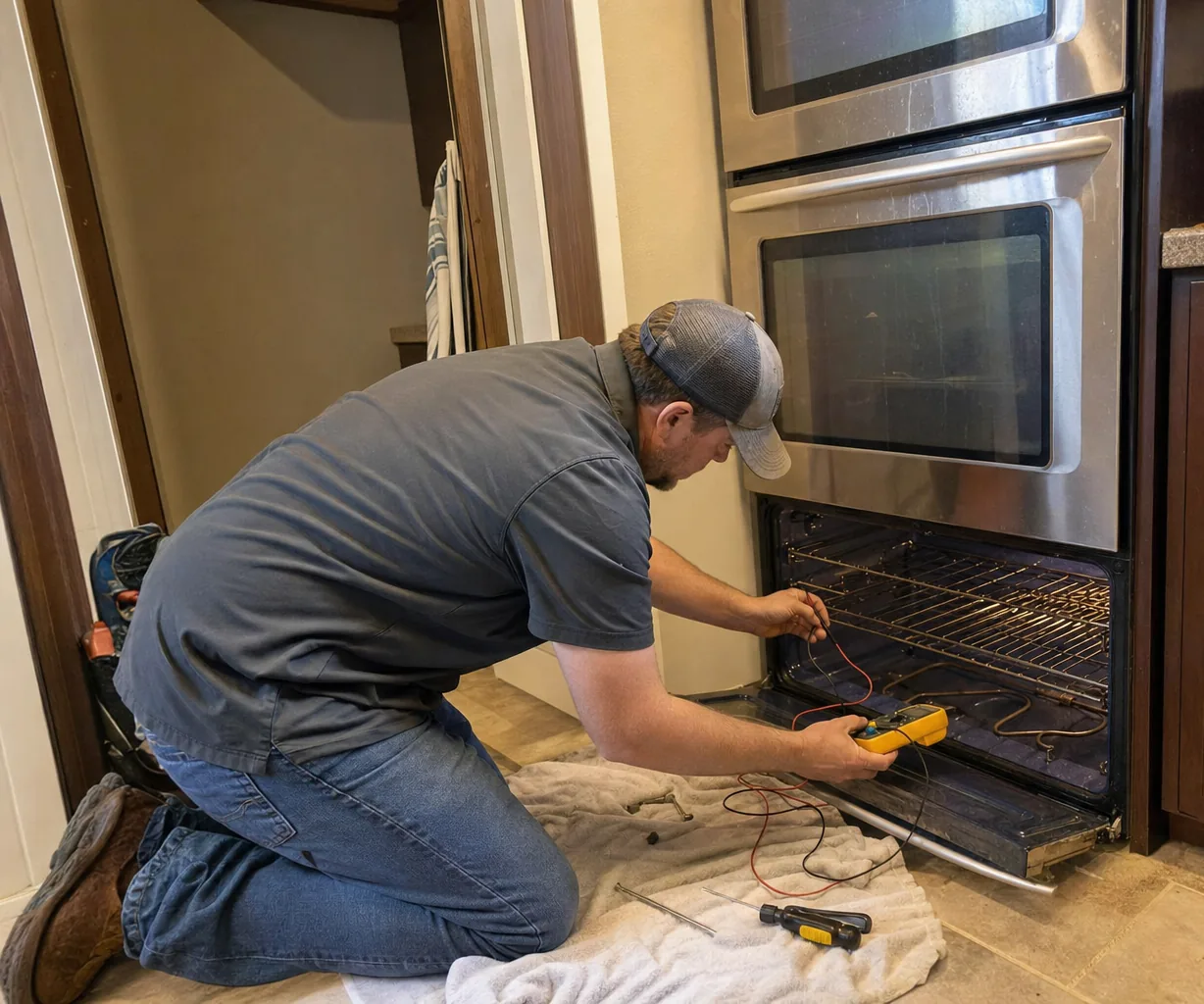
2.4.1 What the appliance is actually doing
A convection steam oven is two machines sharing a cavity. One is a conventional convection oven with an element and a fan. The other is a small boiler: a reservoir or a plumbed supply, a pump or a fill valve, a line into a generator, an element that boils the water, a sensor in the water path telling the control how hot it is, and a route for what comes back out.
“No steam” is therefore never a single fault. It is a question about which stage of that chain stopped, and the useful part of the visit is finding out which one — before anything is dismantled, and without replacing a part on suspicion.
2.4.2 Does water leave the reservoir
The first measurement is volume. We fill the reservoir to a marked level, run a steam cycle, and see how much is gone. Three outcomes, three different faults.
Water level unchanged: the machine is not drawing. That is the fill pump, the line from the reservoir, or the reservoir seat itself — a seat with mineral crust on it will not seal, and the pump pulls air.
Water leaves but the cavity stays dry: the water is going somewhere other than the generator, or the generator is not heating it.
Water leaves and steam appears, but the cavity never reaches full humidity: partial output, which is the classic scaled generator.
2.4.3 What deposit does inside the circuit
Deposit on a heating element is an insulator. To move the same heat into the water the element has to run hotter, so it spends longer at a higher temperature every cycle, which lays down more deposit and shortens its own life. The failure accelerates rather than progressing steadily, and owners describe it exactly that way: fine for years, then noticeably worse over one season.
Deposit also lands on the temperature sensor in the water path. A sensor under crust reads the water as cooler than it is, the control keeps calling for heat, and cycles run long or abort on a protection limit.
2.4.4 Drain, not just fill
Steam ovens that empty back to a drain tray or a residual reservoir can fail on the outgoing side. A drain restricted by scale leaves water standing in the cavity floor after a cycle, which the owner reports as a leak. Standing water in a warm cavity also drives the deposit further into the seams. We check both directions before condemning anything.
2.4.5 When descaling is no longer the answer
Chemical descaling removes soft, recent deposit. It does not recover a generator that has been run for years without one. Past a certain point the scale is hard, layered and bonded, and the descaling agent reaches only the outer surface. The honest answer then is replacement of the affected assembly, and we would rather say so at the diagnostic than sell three descale visits that were never going to work.
Use the manufacturer’s own descaling product. Household vinegar is frequently recommended online and it attacks seals, gaskets and aluminium components in these circuits. It is one of the few “harmless” home remedies that reliably turns a repairable machine into a parts order.
2.4.6 If a part is needed
Steam-circuit components are ordered against the data plate — the model and serial number, not a description of the part. Manufacturers revise components inside a model run, so two appliances with the same model number in different serial ranges can take different generators, valves and gaskets. Sending us a photograph of that plate when you book is the single most useful thing an owner can do, and it is how a first visit becomes a repair rather than a survey.
Access is the other half of the job. A built-in steam oven usually has to come forward out of its opening before the water side is reachable at all, which means clearing the run in front of it, protecting the floor, and, on a unit mounted in a column, a two-person lift. If the appliance is plumbed rather than filled by hand there is a supply to isolate as well. None of that changes the price; it changes how long the visit takes, so it is worth mentioning when you book.
2.4.7 What the visit involves
Fill-volume test, generator inspection, pump and valve test, sensor resistance against the water temperature we measure independently, and a full steam cycle logged from cold. Written estimate before any part is fitted. The flat diagnostic is credited toward the repair when you approve the work.
Wolf equipment only.
What does this repair cost in Nocatee?
$80 flat to come out and find the fault, credited in full against the repair when you approve it. Beyond that, the work below is what these jobs run to once parts and labour are counted — $80 at the low end, $1,070 at the top of the widest band on this page.
| No. | Work | Completed, parts and labour |
|---|---|---|
| 2.04.6.01 | Flat diagnostic fee | $80 |
| 2.04.6.02 | Oven thermostat or temperature sensor | $180–$520 |
| 2.04.6.03 | Control board or touch panel | $460–$1,070 |
| 2.04.6.04 | Door hinge, glass or seal | $200–$670 |
| 2.04.6.05 | Burner valve or orifice service | $230–$660 |
A range, because the firm figure is written down after the diagnosis and not before it. The band a job lands in depends on which part failed, whether the appliance has to come out of the cabinetry to reach it, and what the part costs the week it is ordered. A written estimate is provided before any repair begins. No work starts without your approval.
Questions about wolf steam oven, no steam
- Does water leaving the reservoir mean the fill system is working?
- It is the first thing we establish, because it sends the visit in one of two directions. Water leaving the tank with no steam arriving puts the fault at the generator or its heating circuit. Water not leaving the tank at all puts it at the pump, the fill valve, or a line closed by deposit.
- When is descaling no longer the answer?
- When deposit has already damaged something. A generator run hard under scale can have a failed element or a thermal fuse that has opened, and a level sensor sitting under crust reads wrongly however clean the circuit becomes. At that point a part is fitted and descaling becomes aftercare rather than the repair.
Cross-index
2.04.8.1Other repair entries
- 2.01Wolf oven not heating, or driftingWall oven, Range
- 2.05Wolf panel dark, no responseWall oven, Speed oven, Warming drawer
2.04.8.2Reference
- 4.01Storms and boardsPower and storms
- 4.02Access and clearanceInstallation
- 4.03Maintenance calendarMaintenance
- 4.05Parts and lead timesParts
- 4.07Self-cleanMaintenance
2.04.8.3Where we are called out
- 3.01Twenty Mile32081 · Nocatee village
- 3.02Coastal Oaks32081 · Nocatee village
- 3.04Greenleaf Village32081 · Nocatee village
- 3.05Seabrook Village32081 · Nocatee village
- 3.07Lakeside32081 · Nocatee village
What owners said after this repair
4.5 out of 5, from 63 published entries. Each is one visit, in the words of the person who paid for it.
The pump buzzed but moved nothing at all. He took it out, showed me the impeller packed solid, and fitted a new pump along with an inlet screen so it will not swallow the same grit next year.
Reginald E.
Steam stopped halfway through and the tank light came on with a full tank. He cleaned the contacts in the reservoir housing, which had gone dull from the hard water here, and it has read correctly since.
Marcella D.
Steam output had fallen away over a year to almost nothing. There was heavy scale in the generator, which he descaled and then set out a routine for, given how hard the water runs in this part of the county.
Barnaby T.