4.04
New-build kitchens: power and gas
Circuits, fuel type, clearances and duct runs decided during construction set the fault list an appliance will produce years afterwards. This entry says which details matter.
- Category
- Installation
- Equipment
- Range · Rangetop · Cooktop · Wall oven · Speed oven · Ventilation hood · Outdoor grill
4.4.1 Installation decides the fault list
Nocatee’s housing dates from 2007 onward, so almost every kitchen we work in was built to current practice by a production builder rather than assembled piecemeal over decades. That is mostly good news. It also means the faults are consistent: when something was done in a way that stores up trouble, it was usually done that way on a whole street.
These are the details that come back to us as service calls two to eight years later.
4.4.2 Circuits, and where they actually fail
Built-in cooking appliances sit on dedicated circuits, and a column of two or three appliances may be fed by more than one. Sizing is rarely the problem in new construction. Termination is.
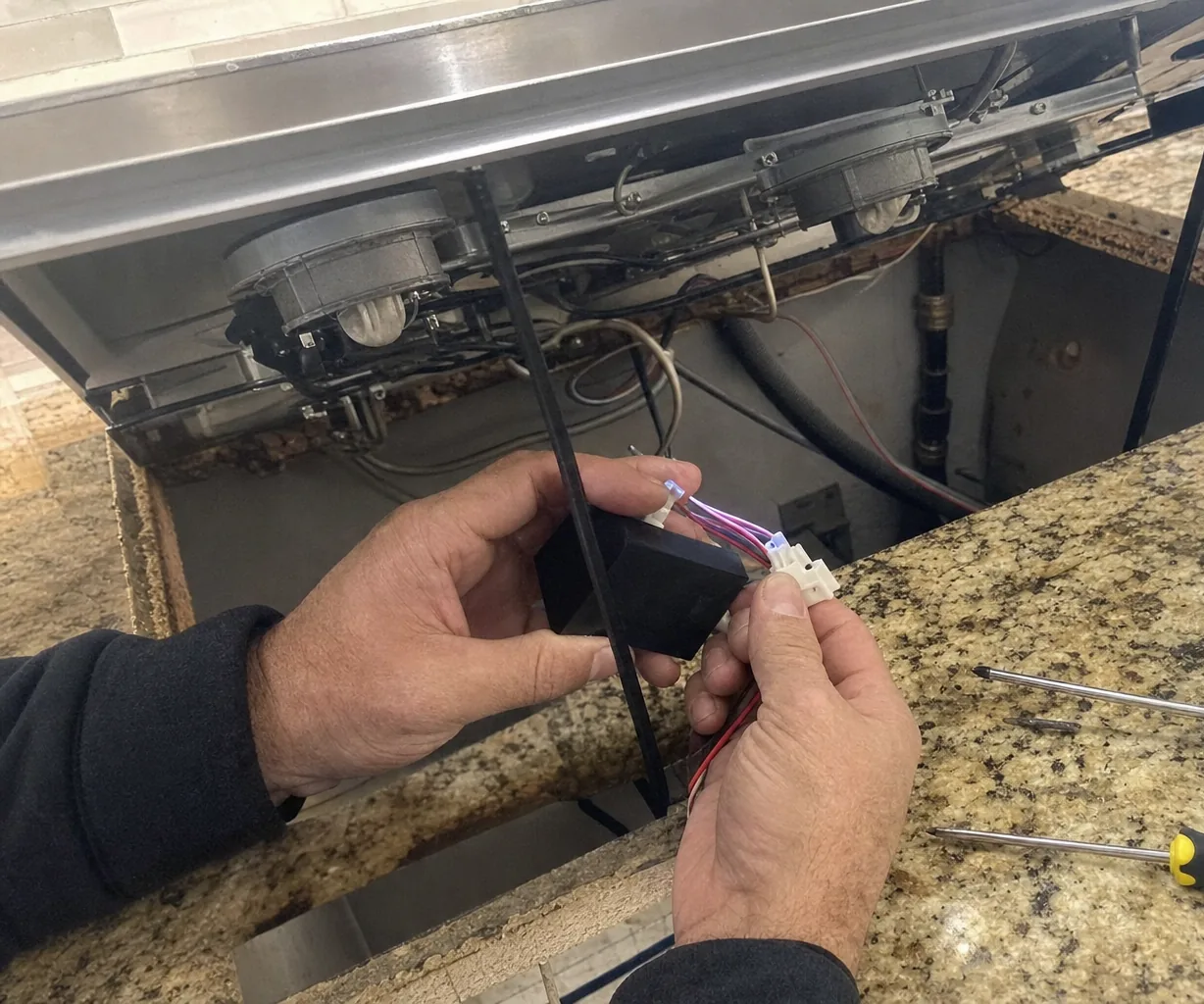
The faults we find are in the last few feet: a lug that was never fully torqued, a terminal that has heat-cycled loose over years, a connection cooked by its own resistance. A full-size induction cooktop is fed by two hot legs, and losing one does not kill the appliance — some elements keep working and others do nothing, which looks like a random board failure and is not. We measure at the appliance junction box, not at the panel.
4.4.3 Fuel type has to match the hardware
Gas appliances are set up for one fuel. Natural gas and liquid propane use different orifices and different regulator settings, and an appliance fed the fuel it was not configured for will either burn yellow and lift off the ports or refuse to hold a simmer.
Conversion is a defined procedure with defined parts. It is not an adjustment, and it is not something to improvise. If a house has changed fuel supply, or an appliance has been moved from one property to another, the setup is the first thing to confirm.
4.4.4 Openings, clearances and the cooling path
Every built-in appliance has a specified cutout and a specified route for cooling air. Both are decided during construction and both get altered afterwards, usually with good intentions.
What we find: cavities lined or insulated after the appliance went in, trim kits from a different model used to close a gap, drawers under cooktops loaded so full that the return air path is blocked, and island panels fitted flush where the installer had left a gap on purpose.
The appliance responds by protecting itself. It cuts power, drops a speed, or opens a thermal cutout. Everything then tests good, which is why this class of fault gets diagnosed as electronic more often than anything else in this index. An open thermal cutout is a symptom. Replacing it without finding out why it opened books the same visit again in six months.
4.4.5 Hood ducting and makeup air
In a new house the entire duct run is above finished ceiling, so nobody sees it again. What we can assess is the canopy and the termination, and that is where most restrictions turn out to be: a damper at the cap stuck part-closed with grease, a screen silted up, or a run reduced in diameter to clear framing.
Flexible duct used where rigid was specified costs airflow permanently. Elbows stacked close to the blower outlet cost more than the same elbows spread along the run.
Makeup air is the other half. A tightly built house cannot supply a high-capacity hood on its own, and current residential code requires makeup air above a threshold set by the code in force. In newer St. Johns County construction the provision is usually installed as a powered damper or an interlocked supply. When it fails closed, the hood runs at full speed and achieves very little, and in a house with any combustion appliance that is a safety matter rather than an inconvenience.
4.4.6 The outdoor kitchen
Built-in grills bring their own installation questions: fuel type again, a supply run that may be shared with the pool or house equipment, an island with the ventilation openings the appliance requires, and a ground connection for the ignition circuit that will corrode faster than anything indoors.
4.4.7 What we do and do not do
We diagnose and repair Wolf cooking equipment, and part of that is telling you plainly when the appliance is sound and the installation around it is not. We do not perform electrical or gas-line work that belongs to a licensed contractor, and we will say when that is what a fault needs.
What does the repair behind this note cost?
$80 flat to come out and find the fault, credited in full against the repair when you approve it. Beyond that, the work below is what these jobs run to once parts and labour are counted — $80 at the low end, $1,070 at the top of the widest band on this page.
| No. | Work | Completed, parts and labour |
|---|---|---|
| 4.04.6.01 | Flat diagnostic fee | $80 |
| 4.04.6.02 | Oven thermostat or temperature sensor | $180–$520 |
| 4.04.6.03 | Burner valve or orifice service | $230–$660 |
| 4.04.6.04 | Igniter or spark module replacement | $190–$550 |
| 4.04.6.05 | Control board or touch panel | $460–$1,070 |
A range, because the firm figure is written down after the diagnosis and not before it. The band a job lands in depends on which part failed, whether the appliance has to come out of the cabinetry to reach it, and what the part costs the week it is ordered. A written estimate is provided before any repair begins. No work starts without your approval.
Questions this note answers
- How can the installation still be causing faults years later?
- Because circuits, fuel type, cabinet openings and duct runs are settled during construction and none of them change afterwards. A cooling path that was never adequate, or a hood run in flexible duct where rigid was specified, produces the same fault every year until somebody addresses the installation itself.
- Does the appliance have to match the fuel the house is fed?
- Yes, and it is worth confirming. Orifices and the pressure regulator are fuel-specific, so equipment set up for piped gas and fed propane, or the reverse, will either burn yellow and lift off the ports or refuse to hold a low simmer. Converting it is a hardware change, not a setting.
Cross-index
4.04.8.1Repair entries
- 2.01Wolf oven not heating, or driftingWall oven, Range
- 2.02Wolf burner clicks, no flameRange, Rangetop, Cooktop
- 2.03Wolf induction drops outCooktop, Range
- 2.05Wolf panel dark, no responseWall oven, Speed oven, Warming drawer
- 2.06Wolf hood noisy or weakVentilation hood
- 2.07Wolf grill heats unevenlyOutdoor grill
4.04.8.2Other reference entries
- 4.01Storms and boardsPower and storms
- 4.02Access and clearanceInstallation
- 4.05Parts and lead timesParts
- 4.06GlossaryGlossary
- 4.07Self-cleanMaintenance