2.01
Wolf oven that will not heat, or drifts off setpoint, in Nocatee
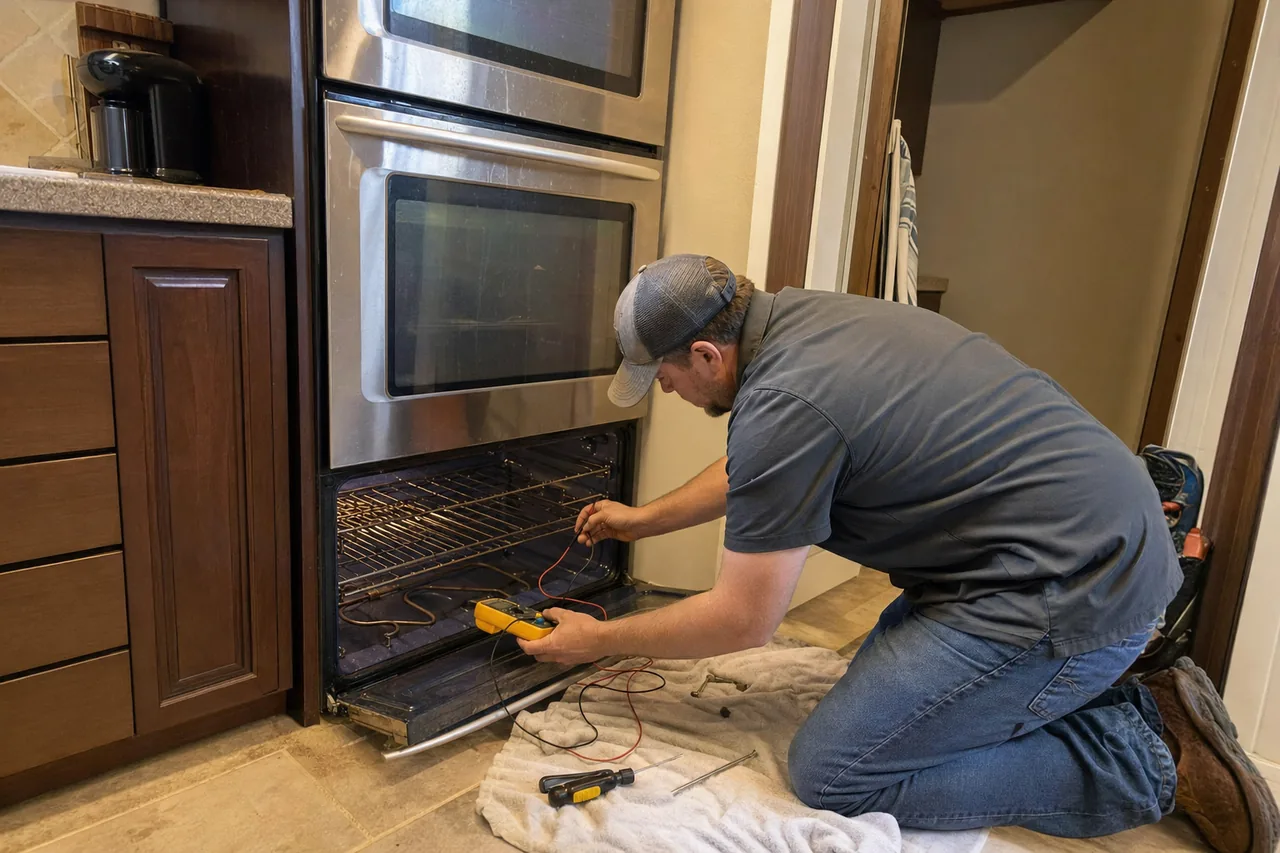
2.1.1 What we measure first
Temperature complaints are rarely settled by the display. We put an independent probe in the cavity and log the actual swing over a full cycle. A well-behaved oven cycles in a narrow band around the setpoint. An oven that swings wide, or that settles a fixed amount away from the setpoint, is telling you two different stories, and they point at different parts.
The log matters more than any single reading. An oven photographed at one moment can be made to look perfect or terrible depending on where in its cycle you catch it, which is why a reading taken at the door with a hand-held probe usually starts an argument rather than ending one.
2.1.2 Fixed offset
A cavity that sits consistently low or consistently high across every setpoint usually points at the temperature sensor or the control’s calibration. Sensors drift with age rather than failing outright, which is why the symptom creeps in over months instead of appearing overnight.
A sensor is measurable. Its resistance corresponds to a temperature, and we compare what it reports against what our own probe reads in the same cavity at the same moment. When the two disagree by a consistent amount, the sensor has told us it is the fault. When they agree and the food still comes out wrong, the sensor is innocent and we keep looking.
2.1.3 Wide swing
A cavity that overshoots and then falls away is a heat-delivery problem: an element that has lost part of its resistance, a relay that is slow to drop out, or a convection fan that is no longer moving air across the cavity.
Convection is worth separating out. A fan that has slowed, or a motor that runs but no longer holds speed under load, leaves the cavity heating by radiation alone. The oven still reaches temperature at the sensor and still cooks unevenly, and to the person using it that reads as an oven with hot spots rather than a fan fault.
2.1.4 Door and gasket
Before any part is ordered we check the door. A gasket that has hardened, or a hinge that has lost tension, lets enough heat out to mimic every symptom above. This is the cheapest thing on the list and it is checked first.
Hinges are the part people never suspect. They carry the door’s weight through thousands of cycles, and as the springs weaken the door stops pulling itself tight against the gasket along its top edge. The leak is small, continuous and invisible, and it costs the cavity real temperature at exactly the setpoints used for baking.
2.1.5 Elements, relays and boards
An element that has failed completely is easy. An element that has partly failed is not: it still glows, still draws current, and still delivers less heat than the control expects. We measure resistance rather than looking at it.
Relays on the control board switch the elements, and a relay with pitted contacts closes late or holds closed after it should have released. Both produce a wide swing. Both are found by watching what the control commands against what the element actually does, which is why the diagnostic involves a full cycle rather than a quick look.
2.1.6 When it will not heat at all
No heat is a different question from bad heat, and an easier one, because most of the appliance has already proved itself. The display lit, the control took a setting, the interlock let it start. What is left is the heat source and the one switch that feeds it.
On an electric cavity that is a continuity question and the answer is not a matter of degree: an element that has opened is out of circuit and the cavity cannot heat however patiently the control asks. A relay that no longer closes looks identical from the front of the appliance and nothing like it on a meter, which is why both get measured rather than one being assumed.
On a gas cavity the igniter is not merely a flame source — the current drawn through it is what opens the safety valve. An igniter that has aged draws less of it every year, which is how an oven can glow brightly at the burner for a long minute and never light. We measure that current instead of judging the colour, because the colour is the least reliable thing in the cavity.
One more history is worth volunteering when you call: whether the fault began after a self-clean. That cycle is the hottest thing an oven ever does, and the thermal cutout that exists to interrupt it leaves an appliance that looks perfectly normal and will not heat at all. It moves the cutout, the door latch and the cooling fan to the front of the test order.
2.1.7 What we will not do
We will not fit a temperature sensor because the symptom sounds like a sensor. Parts fitted on suspicion are how a repair bill doubles without the fault changing. If the measurement does not identify the part, we keep measuring.
2.1.8 What the visit costs
The diagnostic is flat and it is credited toward the repair when you approve the work. You get a written estimate before anything is replaced, with the part, the labour and the expected lead time set out. Wolf cooking equipment only.
What does this repair cost in Nocatee?
$80 flat to come out and find the fault, credited in full against the repair when you approve it. Beyond that, the work below is what these jobs run to once parts and labour are counted — $80 at the low end, $690 at the top of the widest band on this page.
| No. | Work | Completed, parts and labour |
|---|---|---|
| 2.01.6.01 | Flat diagnostic fee | $80 |
| 2.01.6.02 | Oven thermostat or temperature sensor | $180–$520 |
| 2.01.6.03 | Burner valve or orifice service | $230–$660 |
| 2.01.6.04 | Igniter or spark module replacement | $190–$550 |
| 2.01.6.05 | Convection fan or motor | $260–$690 |
A range, because the firm figure is written down after the diagnosis and not before it. The band a job lands in depends on which part failed, whether the appliance has to come out of the cabinetry to reach it, and what the part costs the week it is ordered. A written estimate is provided before any repair begins. No work starts without your approval.
Questions about wolf oven not heating, or drifting
- How do you prove an oven is drifting rather than the recipe being wrong?
- We log the cavity against an independent probe through a full heat-and-soak cycle instead of trusting the display. That separates a fixed offset, which points at the sensor or at calibration, from a wide swing around the setpoint, which points at the element, the relay or the door.
- Why does broil work when bake does nothing?
- They are separate heat sources on separate switching. A working broil has already proved the supply, the control and the door interlock, which is most of the circuit — so a dead bake beside a live broil points at the bake element itself or at the one relay feeding it. Tell us that on the phone and half the diagnosis is done.
- Does resetting the oven fix one that will not heat?
- Sometimes, and it costs nothing to try: drop the breaker for a minute and let the control come up cold. A control that hung after an outage can come back that way. What a reset cannot do is close an open circuit, so a failed element, a dead igniter or a tripped cutout comes back within a cycle or two.
- Can a door seal really change the temperature that much?
- Yes. A gasket that no longer closes evenly, or a hinge that has dropped so the door stands proud at one corner, lets heat leave steadily and the control spends the whole cycle chasing it. You can often feel it on the face of the door, or see browning that runs uneven front to back.
Cross-index
2.01.8.1Other repair entries
- 2.02Wolf burner clicks, no flameRange, Rangetop, Cooktop
- 2.03Wolf induction drops outCooktop, Range
- 2.04Wolf steam oven, no steamConvection steam oven
- 2.05Wolf panel dark, no responseWall oven, Speed oven, Warming drawer
2.01.8.2Reference
- 4.01Storms and boardsPower and storms
- 4.02Access and clearanceInstallation
- 4.03Maintenance calendarMaintenance
- 4.04Power, gas, openingsInstallation
- 4.05Parts and lead timesParts
- 4.07Self-cleanMaintenance
2.01.8.3Where we are called out
- 3.01Twenty Mile32081 · Nocatee village
- 3.03Del Webb Nocatee32081 · Nocatee village
- 3.06Crosswater32081 · Nocatee village
What owners said after this repair
4.5 out of 5, from 63 published entries. Each is one visit, in the words of the person who paid for it.
Temperature swung by a wide margin in both directions. He found the bake element open at one end, which meant the oven was running on the broil element alone in bursts, and replaced it the same visit.
Estelle C.
Bread was burning underneath and pale on top at the same setting. He found the lower element sitting out of position after an earlier repair, refitted it correctly and checked the clearance around it.
Georgina B.
The convection setting ran far hotter than the number on the dial. He calibrated against a probe, found the fan running slow enough to leave a hot pocket at the back, and replaced the motor.
Lavinia M.